Picard is today synonymous with frozen foods in France. The brand with blue facades has not always sold prepared meals or frozen vegetables. Its history begins with a vanished trade: the manufacturing and delivery of blocks of natural ice.
From alpine ice blocks to the domestic freezer: the prehistory of Picard
Before refrigerators, keeping food cool meant buying ice. In 1906, René and Gaston Bajante founded Les Glacières de Fontainebleau, a company that shaped ice blocks from the Alps and sold them to individuals and businesses in the Paris region.
The Picard family bought this company in 1920. For several decades, the activity remained the same: providing cold in the form of blocks. The company officially took the name Picard in 1962, at the time when its owners turned to selling domestic freezers, a piece of equipment that was still rare in French households.
This shift deserves attention. Moving from alpine ice to freezers anticipates a societal change. Families gradually equip themselves, and the demand for ice blocks collapses.
Rather than disappearing with its market, the Picard family changed trades without changing sectors. The common thread remains cold, but the product sold is radically different. A detailed portrait traces the journey of the creator of Picard on Madame Gertrude, with precise chronological markers.
Armand Decelle and the bet on frozen food by mail order
In 1973, an entrepreneur specialized in canned foods, Armand Decelle, bought Picard. This acquisition marked the true commercial turning point for the brand. Decelle did not just sell freezers. He launched mail-order sales of frozen products, with a dozen employees and five delivery vans.
Why mail-order sales? At that time, supermarkets were beginning to offer frozen foods, but the aisles were not very diverse and the quality was variable. Decelle bet on home delivery to differentiate himself from traditional channels. The customer receives a catalog, orders by phone, and gets delivered at home.
A year later, in 1974, the first Picard store opened its doors. The hybrid model (direct sales and delivery) allows reaching two types of customers: those who want to choose in-store and those who prefer home delivery. This dual approach remains a pillar of the brand today.
The no white label model: Picard does not manufacture anything itself
An often-overlooked aspect of Picard deserves explanation. The brand does not own any factories. It does not manufacture any of its products. Picard operates as a contractor: the company designs the recipes, writes the specifications, and then entrusts production to specialized subcontractors.
This model resembles that of certain fashion or sports brands that do not own their own workshops. The advantages are twofold:
- Flexibility: Picard can change suppliers if quality declines, without having to shut down a production line.
- Focus on the finished product: internal teams concentrate on design, ingredient selection, and quality control, not on industrial management.
- Control of fixed costs: without a factory to maintain or machines to amortize, the company reduces its structural costs and allocates more budget to developing new references.
This strategic choice partly explains why Picard renews its catalog so frequently. The brand can test new recipes without heavy industrial investment.
Recent ethical commitments and territorial network in 2025-2026
The founder’s legacy continues in the contemporary decisions of the brand. Two recent developments illustrate this continuity.
On the ethical front, Picard has ceased sourcing frog legs from Indonesia, after investigations by NGOs (notably PETA) documenting the cruelty of capture and slaughter methods, as well as their ecological impacts. This type of decision concretely modifies the in-store offer and reflects a growing consideration of societal expectations.
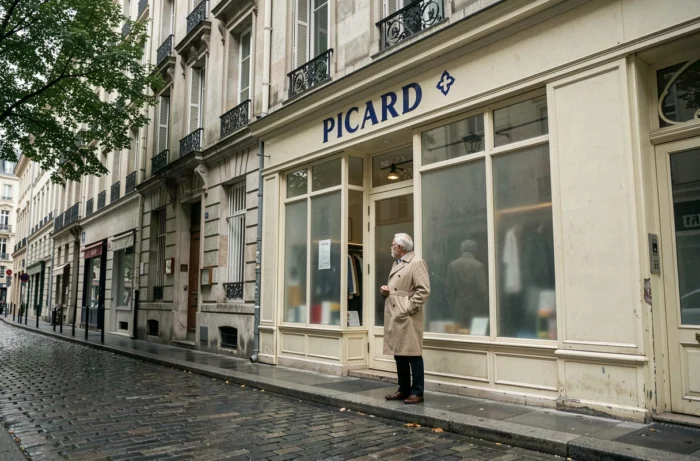
Geographically, expansion does not slow down. The brand opened its eleventh store in July 2026 in Calvados, in Colombelles near Caen, covering 228 m² of sales area. Other openings have been announced in medium-sized cities like Bron or Aire-sur-l’Adour.
This territorial network strategy extends the initial project of Les Glacières de Fontainebleau: bringing cold closer to households, including in areas that do not have the food offerings of large metropolitan areas. The product has changed, but the principle remains the same.
Changes in ownership and stability of the Picard brand
The brand has experienced several changes in shareholders since the acquisition by Armand Decelle. Investment funds have succeeded one another in the capital, with sometimes controversial strategies. The Lion Capital fund, for example, has been associated with controversies regarding the company’s financial management.
What stands out in this succession of owners is the remarkable stability of the brand identity. The name has not changed. The positioning (premium frozen foods, without competing private label brands on the shelves) has not either. The stores maintain their compact format and blue color code.
For a company that has gone through more than a century of existence, several wars, the revolution of domestic freezing, and multiple acquisitions, this consistency is not a detail. It reveals an asset that the different owners have all preserved: the trust of the French consumer in the name Picard.
The story of Picard is not that of a single person or a single founding moment. It is a succession of technical and commercial bets, from the ice of the Alps to frozen foods delivered to homes, carried by different leaders but united by a common intuition: cold is a service before being a product.