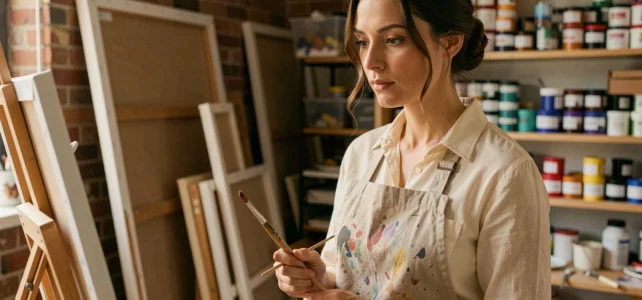
When searching for information about Béatrice Vonderweidt, one comes across photos, biographical snippets, and a lot of speculation. The verifiable data is limited to a few lines: former model, painter, documented exhibitions in Tel Aviv. It is precisely this gap between the visibility of her images and the rarity of her own words that makes her journey unique.
Béatrice Vonderweidt painter: a practice built away from the spotlight
One often expects an artistic reconversion from a personality linked to the fashion world to be highly publicized. Béatrice Vonderweidt took the opposite path. No published interviews, no texts signed by her hand document her transition from modeling to painting.
This silence is not a void. It outlines a stance: letting the canvases speak without constructing a promotional narrative around them. The public traces of her work focus on two events in Tel Aviv, the exhibition “Regards croisés” at the French Institute in 2008 and the presentation “Lumière et présences” at the Caprice Gallery in 2016. The French Embassy in Israel presented her as a painter under the name Béatrice Goldnadel.
One can trace the artistic journey of Béatrice Vonderweidt through these concrete milestones, even if the artist has never sought to connect them in a calibrated storytelling. Her installation in Israel seems to have played a structuring role in her pictorial practice, with a spiritual dimension that permeates her compositions according to recent publications discussing her work.
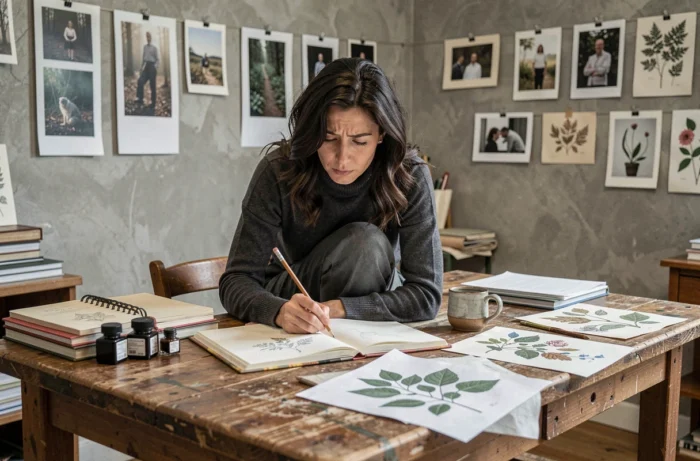
Modeling and painting: what Béatrice Vonderweidt’s reconversion reveals
Moving from modeling to painting is a shift from a profession where one is looked at to a profession where one looks. This transition is not straightforward. Modeling trains the eye to light, proportions, and the staging of the body, but it does not prepare one for the pictorial gesture or the solitude of the studio.
For Béatrice Vonderweidt, the reconversion has not been a communication stunt. It has developed gradually, without a clearly defined public break date. Feedback varies on the exact chronology of this transition, due to a lack of direct sources.
What distinguishes this journey from that of other personalities who have transitioned into art is the absence of media leverage. No Parisian opening covered by the gossip press, no collaboration with a renowned gallery in Europe. The chosen exhibition locations (Tel Aviv, not Paris or London) confirm a process oriented towards a personal geographical anchoring rather than a market strategy.
Béatrice Vonderweidt photo: why her images circulate more than her canvases
A paradox accompanies Béatrice Vonderweidt’s visibility online: her personal photos circulate far more than her pictorial works. The sites that mention her first search for her images, not her paintings. This is a common phenomenon among former models who pivot to the visual arts.
Concretely, this creates an imbalance. Photographic portraits related to her modeling period or social events are easily found. Her canvases, on the other hand, do not have an easily accessible online catalog. No institutional digital gallery seems to host a complete portfolio of her paintings.
The consequences on the perception of her work
This imbalance has a direct effect: Béatrice Vonderweidt is perceived first as a public figure, and only then as an artist. The image takes precedence over the work in the digital space. For those genuinely interested in her painting, it is necessary to go beyond the usual search results and target the archives of exhibition venues.
- Professional shots (fashion shoots, openings) are subject to limited rights transfers in time and usage, complicating their republication
- Personal photos taken at public events raise image rights issues that most online shares ignore
- Her paintings, paradoxically more protected by their limited digital diffusion, remain the least documented aspect of her activity
Discreet muse: what this status means in the contemporary art world
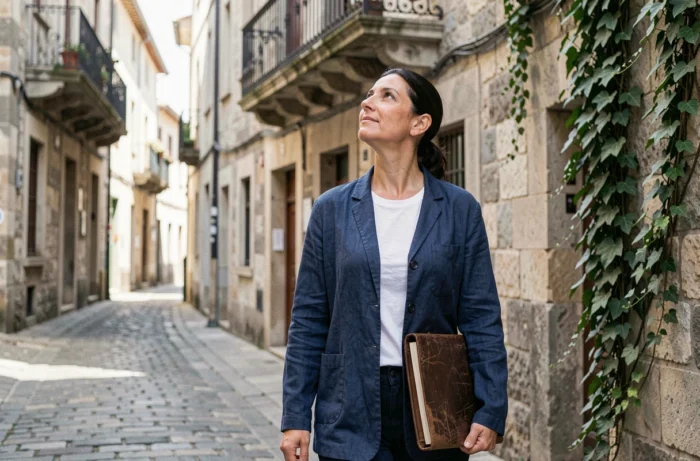
The term “muse” is often overused. It is applied to any female figure associated closely or loosely with a creator. Béatrice Vonderweidt embodies a different model: that of the muse who produces herself. She is not just the object of a gaze; she is also the one who paints.
This dual position (photographed subject and creating artist) blurs the usual categories. In the contemporary art world, the muse is generally confined to a passive role, that of silent inspiration. Béatrice Vonderweidt has chosen not to remain in this assignment while maintaining a discretion that distinguishes her from artist-personalities who saturate social networks.
A chosen visibility, not imposed
One could read her discretion as a lack of professional ambition. It is probably the opposite. Exhibiting in Tel Aviv rather than Paris is a conscious geographical and personal choice, not a lack of connections. The French Institute and the Caprice Gallery are not anecdotal venues: they offer real visibility in a dynamic artistic ecosystem.
The fact that her name appears regularly in online searches, despite the almost total absence of a communication strategy, shows that public curiosity exists. It simply encounters a limited corpus of verifiable information, which paradoxically fuels interest.
Béatrice Vonderweidt’s journey reminds us that digital notoriety and artistic recognition do not follow the same paths. Her canvases remain to be discovered for those willing to search beyond the first pages of results, where images give way to the pictorial work itself.