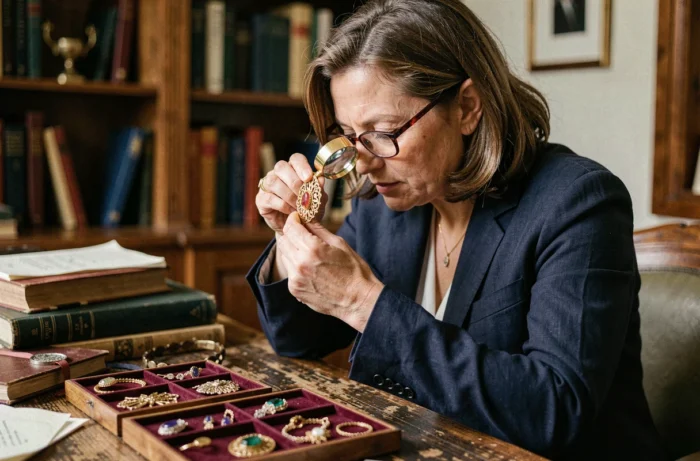
You’re holding an antique ring found in a family jewelry box. A tiny engraved mark inside the band catches your eye. It isn’t the eagle’s head you’ve seen on French jewelry before. The symbol is different—perhaps a number, perhaps a letter in an unusual frame. It’s probably a foreign gold hallmark, and reading it doesn’t follow the same rules as the French system.
Foreign gold hallmarks and import marks: two marks, two purposes
Before looking for the origin of an antique piece of jewelry, it’s important to distinguish between two types of marks that may sometimes appear on the same piece. The original hallmark is applied in the country where the piece was made. It generally indicates the metal’s fineness (the proportion of pure gold) and sometimes the maker’s identity.
An import mark, on the other hand, is a French mark. It was stamped by the Assay Office when the jewelry entered the country. Its presence means that an official inspection took place in France.
A foreign hallmark alone does not guarantee that the piece meets France’s legal fineness standards. The French import mark certifies compliance with local law. An antique piece may bear only its original hallmark, with no import mark, if it never passed through official channels. That doesn’t mean it’s fake.
To better identify a foreign gold hallmark on an antique piece of jewelry, you first need to know which marking system the country of origin uses, since each jewelry-making tradition has its own codes.
Carat and fineness markings: decoding the engraved numbers
You’ve spotted a number on your jewelry: 750, 585, 375, or perhaps 18K, 14K, 9K. These markings refer to the same thing, expressed differently depending on the country.
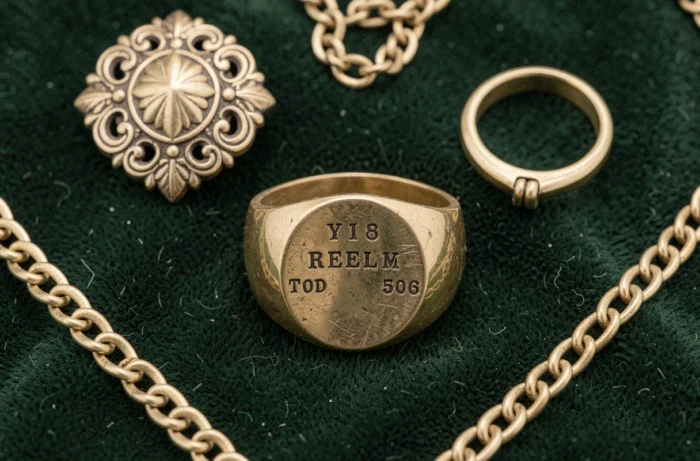
The parts-per-thousand system is common in continental Europe. The number 750 means the alloy contains 75% pure gold. The carat system is used in the United Kingdom, the United States, and much of the Middle East. 18-carat gold is equivalent to 750 parts per thousand.
Here are the most common equivalents found on antique foreign jewelry:
- 750 or 18K: 75% pure gold, the most widely used standard in European and Middle Eastern jewelry
- 585 or 14K: 58.5% pure gold, very common in Germany, the Netherlands, Scandinavia, and the United States
- 375 or 9K: 37.5% pure gold, common in the United Kingdom and Australia; this fineness is not recognized as gold in France
- 916 or 22K: 91.6% pure gold, traditional in India, the Gulf countries, and the Maghreb
An antique piece marked 14K doesn’t contain as much gold as one marked 18K, even if both are genuine. The fineness directly determines the value of the metal in the piece.
Common foreign hallmark symbols and shapes
Unlike the highly codified French system, with its animal figures (eagle, owl, shell), foreign hallmarks vary considerably from one country to another. Some use symbols, while others consist only of numbers or letters.
In the United Kingdom, the hallmarking system is long-established and structured. An English piece of jewelry may bear four separate marks: the assay office symbol (an anchor for Birmingham, a leopard for London), a date letter that identifies the year of manufacture, the carat fineness, and the maker’s mark.
British hallmarks can date a piece of jewelry to within a year. This is a considerable advantage when appraising an antique piece.
In Italy, the hallmark takes the form of a star followed by a province number and a maker’s code. In Germany, you’ll often find a simple number (585 or 750) accompanied by a crescent moon and a crown, the historic mark of the German assay office. In the United States, there is no official state hallmark: the maker stamps the carat fineness themselves, making verification less certain.
In the Maghreb, hallmarks sometimes feature Arabic inscriptions and fineness numbers in parts per thousand. 18-carat gold is the standard for wedding jewelry and traditional sets.
Estimating the value of antique jewelry with a foreign hallmark
A hallmark gives you an initial indication of the metal’s fineness, but resale value depends on the sales channel, not just the price of gold. A piece sold for melting will be valued according to its fine-metal weight. A piece sold as an antique or signed item may fetch a considerably higher price.
Three factors matter when making an accurate estimate:
- The metal’s actual fineness, confirmed by a professional test (touchstone or X-ray fluorescence), not just by reading the hallmark
- The jewelry’s weight, which determines its intrinsic precious-metal value at the current market price
- The piece’s historical or aesthetic appeal: period, signature, model rarity, and condition
A worn or partially erased hallmark doesn’t make a piece worthless. The absence of a legible mark does not settle the question of what the metal is. Marks may have been worn down over decades of use or altered during a repair. A jeweler equipped with an X-ray fluorescence analyzer can determine the exact composition without damaging the piece.
Avoid at-home acid tests on antique jewelry that may be valuable. This type of test leaves a mark and can devalue a piece that deserves a more careful appraisal.
Since the ordinance of December 20, 2023, regulations on precious metals have been transferred from the General Tax Code to the Commercial Code. This change mainly affects professionals, but it’s a reminder that having antique jewelry appraised by a qualified professional remains the most reliable step before deciding to sell. Anyone selling without an appraisal risks undervaluing a rare piece or overvaluing jewelry whose hallmark doesn’t match the actual metal.