
We’re looking for an idea for a planting bed on a challenging slope, a shrub suited to alkaline soil, or simply a visual spark to get a stalled landscaping project moving again. The usual approach is to type keywords into a search engine and get lost in dozens of tabs. A well-structured sitemap makes the process quicker: all the pages on a resource appear on a single screen, organized by topic and ready to scan at a glance.
Navigate by real-world problem, not decorative category
Most gardening websites organize their content by plant type or season. There’s a “perennials” tab, a “shrubs” tab, and a “vegetable garden” tab. This approach works when you already know what you want to plant.
But when you’re starting with a problem in your garden—a north-facing wall, brambles that come back every spring, or a tree planted too close to the house—searching by category gets you nowhere. You need an article that addresses the constraint, not the plant.
Browse the Escapades aux Jardins sitemap and you’ll spot titles focused on practical situations, such as which trees to plant near a house or how to get rid of brambles without herbicide. This type of content answers a specific question that conventional menu navigation doesn’t bring to the surface.
Here’s a practical tip: open the sitemap in a tab, then use your browser’s search function (Ctrl+F or Cmd+F) to look for a word related to the problem you’re facing. Type “shade,” “slope,” “alkaline soil,” or “fence” to instantly filter the relevant articles from all the pages listed.

Garden sitemap: a tool for keeping up with new content
A sitemap isn’t static. Every new article appears in it, often at the top of the list or in a dated section. For anyone following gardening news, it’s a straightforward information feed, without recommendation algorithms or ads in between.
Escapades aux Jardins highlights a “Top du moment” section featuring a mix of botany, landscape design, and plant uses. The sitemap makes it easy to check whether new topics have been added since your last visit, without relying on a newsletter or social media feed.
What you can find faster in the sitemap than in the menu
- Niche articles that don’t appear in any of the menu’s main categories, such as a guide to agricultural herbicides or a comparison of trees for small gardens
- Cross-disciplinary topic pages that bring together several subjects (landscaping, maintenance, plant selection) but are filed under just one section in a hierarchical menu
- Seasonal content published occasionally, visible on the homepage for a few weeks before disappearing into the archives
A sitemap works like a book’s table of contents: scan the titles, spot an unexpected angle, and click. There’s no need to know how the site is structured or guess which submenu a page is filed under.
Turn online inspiration into a practical landscaping project
Finding an inspiring article isn’t enough to get a project underway. The next step is to turn a visual idea or planting tip into a list of actions suited to your own garden.
When exploring a sitemap rich in gardening content, bringing together three or four complementary articles speeds up the planning stage. For example, combining an article on choosing trees with one on landscape design and a third on chemical-free maintenance gives you a coherent framework for planning a mixed hedge.
Build a focused reading path
You can work through a sitemap using a simple method: first identify articles related to your main constraint (soil, exposure, or space), then find those covering your preferred style (natural, structured, Mediterranean), and finally look for care guides relevant to the plants you’re considering.
This three-step approach keeps you from flitting between dozens of pages without a clear direction. It turns a sitemap into a personalized learning path tailored to a specific project.
Complement online research with visits to real gardens
Inspiration from a website becomes more meaningful when you compare it with plantings you’ve seen in person. A flower bed photographed from a flattering angle tells you nothing about how it fares in midsummer, how much maintenance it needs, or what it will look like in three years.
Directories such as Jardinez.com help you find public parks and gardens by department or region. Events such as “Rendez-vous aux Jardins” open up places that are usually closed to the public each year, with owners on hand to answer practical questions.
Combining online reading with in-person observation gives you reliable points of reference: you can check whether a shrub lives up to its promise, get a sense of the true scale of a landscaping feature, and note plant combinations that thrive in a climate similar to yours.
Organize your discoveries and make progress
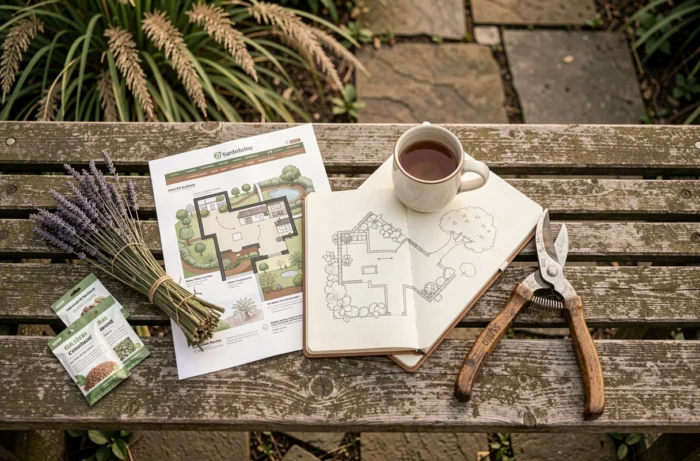
A notebook—paper or digital—for recording useful article links, plant names, and gardens you’ve visited is a simple project-planning tool. The sitemap then becomes a regular starting point: come back every few weeks to see whether new content answers a question you still have.
The range of topics covered by a site like Escapades aux Jardins, from plant selection to landscape design, makes this habit worthwhile. You’re not looking for a single answer; you’re gradually building a vision for your garden, article by article and visit by visit.