Cleaning a school cafeteria is not just about mopping the floor after service. Between the EN 14476 standard required for virucidal disinfectants, the TACT method that conditions the actual effectiveness of products, and the documentary traceability imposed by the health control plan, there are many parameters to consider. What gaps separate a compliant cleaning protocol from a rough routine, and on what criteria can the difference be measured?
TACT Method and EN 14476 Standard: Parameters That Condition Effectiveness
Most cleaning guides in school catering list products without specifying the conditions under which they actually work. The TACT method structures these conditions around four inseparable variables: Water temperature, Mechanical action, Concentration of the detergent or disinfectant, and Contact time on the surface.
Altering any one of these parameters without adjusting the others reduces overall performance. A virucidal disinfectant compliant with the EN 14476 standard loses its effectiveness if the contact time recommended by the manufacturer is not respected, even with the correct concentration.
| TACT Parameter | Risk of Non-Compliance | Control Point |
|---|---|---|
| Temperature | Incomplete dissolution of the detergent, persistent greasy residues | Check the water temperature before dilution |
| Mechanical action | Biofilm not removed despite the product | Effective scrubbing on each surface, not just spraying |
| Concentration | Under-dosing = ineffectiveness, over-dosing = chemical residues | Use calibrated dispensers |
| Contact time | Incomplete disinfection even with an EN 14476 virucide | Respect the duration indicated on the product data sheet |
This table summarizes the operational framework that each cafeteria worker should master before handling a bottle. Applying the school cafeteria cleaning protocol requires checking these four variables at each intervention, not just during initial training.
Cleaning Sequence in Cafeteria: From Cleanest to Dirtiest
The order in which areas are cleaned directly affects the sanitary outcome. The principle of cleaning from cleanest to dirtiest prevents the transfer of contaminants from a high-risk surface to a surface that has already been treated.
In a school cafeteria, this sequence translates into a precise chain of actions:
- Remove food waste and empty trash cans before any cleaning operation, to avoid spreading organic matter on clean surfaces
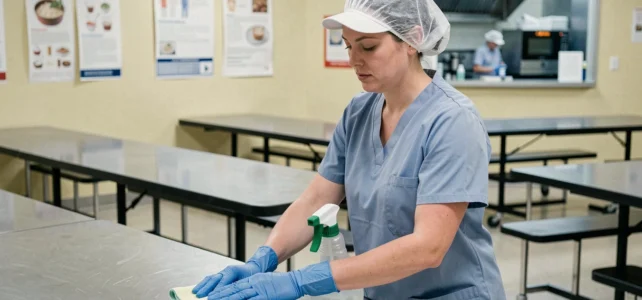
- Clean work surfaces and cafeteria tables with an appropriate detergent, then disinfect with a compliant virucidal product, respecting the contact time
- Treat frequently touched contact points (door handles, switches, railings) that accumulate microorganisms throughout service
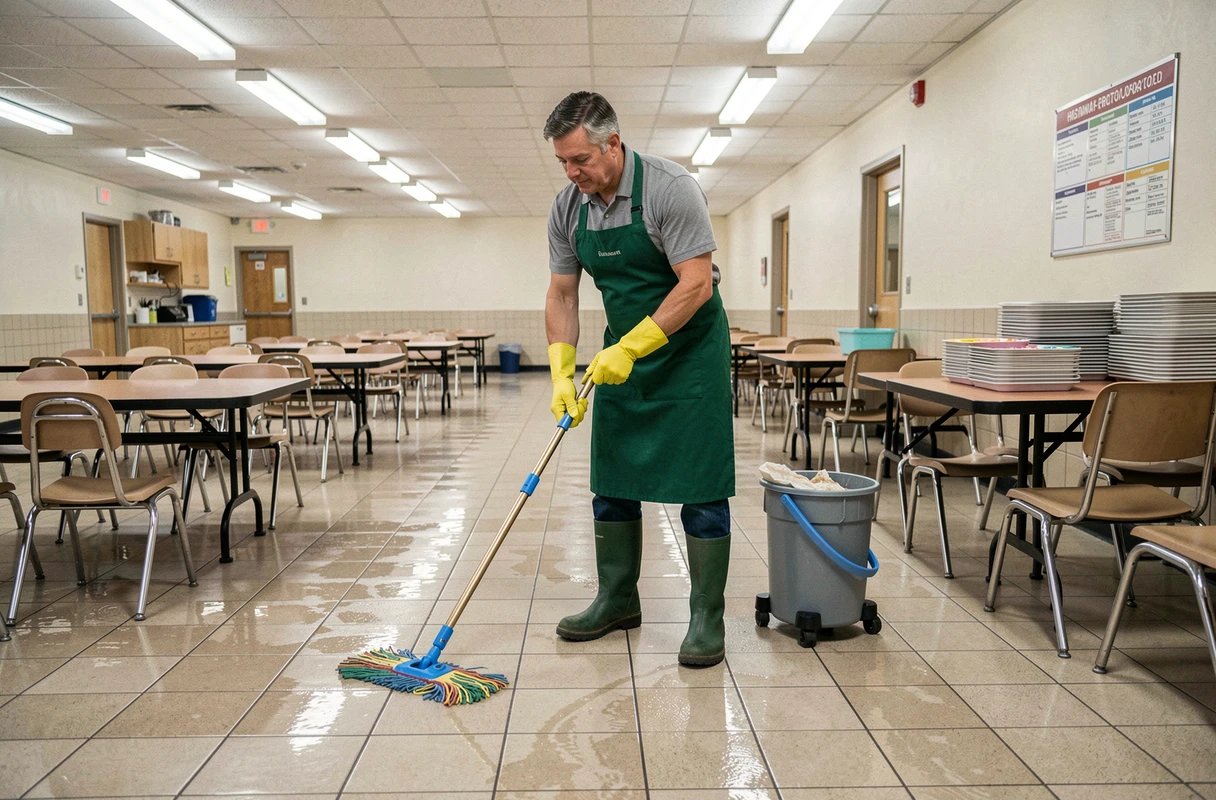
- Finish with the floors, which receive all the splashes and residues from the previous steps
Cafeteria tables must be cleaned and disinfected after each service, as stated in the health protocol sheet from the Ministry of Education. This frequency is non-negotiable: between services, surfaces in direct contact with trays accumulate food residues that promote bacterial proliferation.
Color-Coding of Cloths and Risk of Cross-Contamination
The color-coding system assigns a cloth for each type of area. Mixing a cloth used in restrooms with one intended for cafeteria tables nullifies the purpose of the entire cleaning sequence. This operational detail, often overlooked due to lack of training, is one of the most common gaps between a theoretical cleaning and disinfection plan and its practical implementation.
Cleaning and Disinfection Plan by Area: Frequencies and Traceability
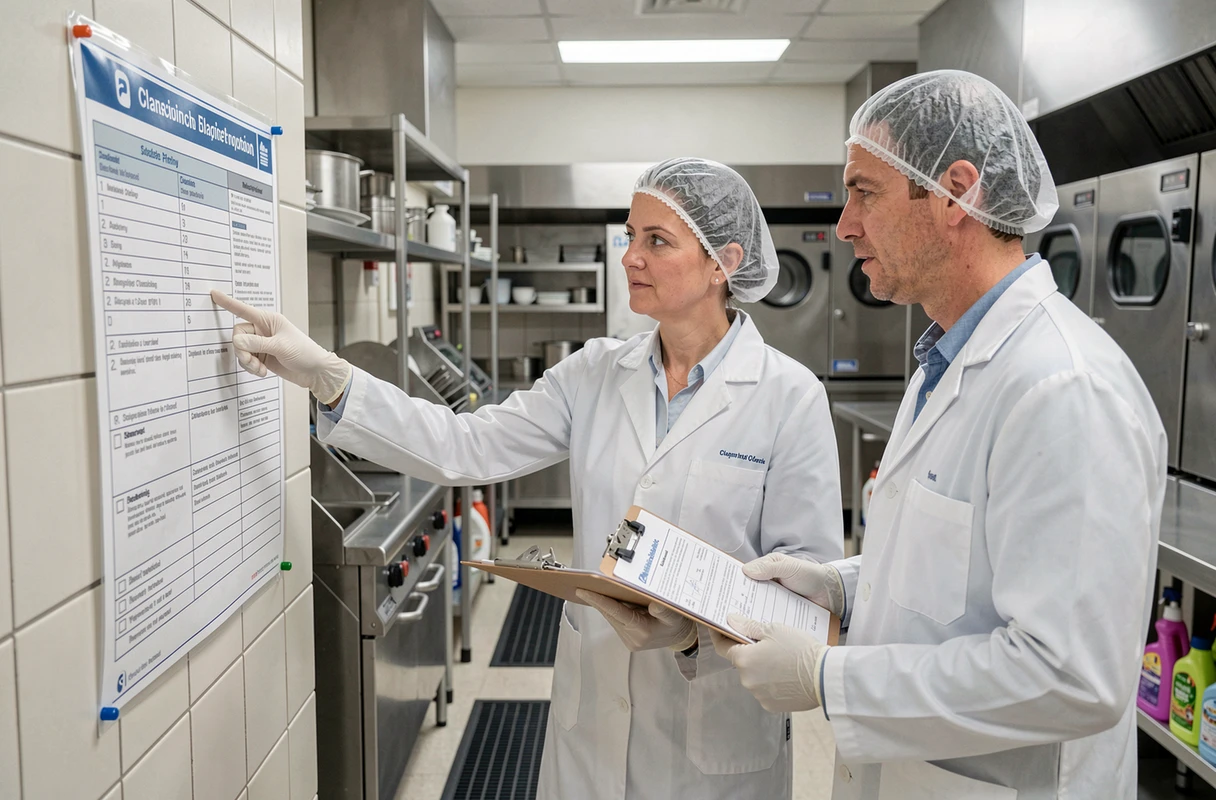
An effective cleaning and disinfection plan (CDP) is not limited to a list of tasks. It maps each area of the cafeteria with the associated product, frequency of intervention, and designated responsible person. Document management is now considered a standalone step in the protocol, not just an administrative supplement.
The CDP must specify, for each area (kitchen, cafeteria, restrooms, storage),:
- The type of cleaning required (detergent only or combined cleaning-disinfection)
- The minimum frequency (after each service, daily, weekly)
- The exact product with its concentration and contact time
- The mode of verification (signed checklist, visual control, spot ATP measurement)
The Ministry of Education indicates that cleaning of floors and large surfaces must be performed at least once a day. For surfaces frequently touched by students and staff, daily disinfecting cleaning with a virucidal product compliant with the EN 14476 standard is required.
ATP Measurement: Objectifying Cleanliness Beyond Visual Control
Visual control remains the dominant reflex in school collective catering. A surface may appear clean while harboring a significant microbial load. ATP measurement measures in seconds the amount of residual organic matter on a surface, providing an objective indicator that a checklist alone cannot offer.
This type of spot control does not replace daily cleaning, but it allows for the detection of areas where the protocol deviates, such as insufficient dosing or shortened contact time due to habit. Combining daily checklists and spot ATP controls enhances the overall reliability of the CDP.
Bleach in School Cafeteria: Backup Solution and Precautions
In the absence of a virucidal disinfectant compliant with the EN 14476 standard, the health protocol sheet from the Ministry of Education allows a solution based on diluted bleach at 0.5% active chlorine. The recommended dilution is one liter of 2.6% bleach for four liters of cold water.
This substitute option comes with strict constraints. Bleach must never be mixed with any product other than water, under penalty of releasing toxic fumes. Compatibility with the nature of the surface must be verified before application. In practice, some coatings of tables or work surfaces in stainless steel react poorly to repeated exposure to chlorine.
This solution remains a temporary measure. A supply plan for products compliant with the EN 14476 standard avoids reliance on a manual dilution subject to dosing errors.
The compliance of a cleaning protocol in a school cafeteria relies less on the choice of a miracle product than on the rigor of four combined variables and their documented traceability. A well-structured CDP, applied in the correct order and verified by objective controls, remains the only reliable lever to maintain a level of hygiene compliant with HACCP requirements in collective catering.