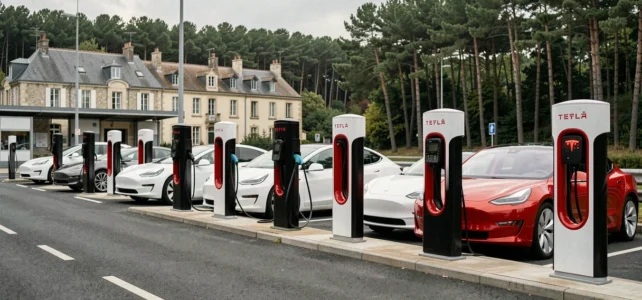
Leaving Lyon for Marseille on a Friday evening in a Tesla Model 3, with a 40% battery, and needing to find a fast charging point within a twenty-minute detour: this is the kind of situation where the Tesla charging network shows its true value. In France, this network relies on two distinct infrastructures, Superchargers and so-called “destination” chargers, which do not meet the same needs at all.
Understanding their concrete functioning, their limitations, and recent developments helps avoid unpleasant surprises on the road.
Supercharger V4 in France: a theoretical power to put into perspective
Tesla has installed its first Supercharger V4 in La Rochelle, with announced power that can rise up to 500 kW per charging point. On paper, we’re talking about a full charge in about ten minutes. The reality is more nuanced.
The Teslas sold in Europe are still limited to about 250 kW for fast charging. The electrical architecture of these vehicles operates at 400 V, while the 500 kW of the V4 primarily targets the 800 V models from other manufacturers. In practice, a Model Y or Model 3 owner plugging their car into a V4 will not see a significant difference compared to a V3.
This paradox is not trivial. Tesla is deploying an infrastructure that benefits, at maximum power, more the competing vehicles compatible with CCS than its own European models. To discover Ma Future Voiture and the specifics of each generation of Supercharger, the detailed technical sheets by model provide a more precise overview than marketing figures.
Tesla network opening to other electric vehicles: what it changes on a daily basis
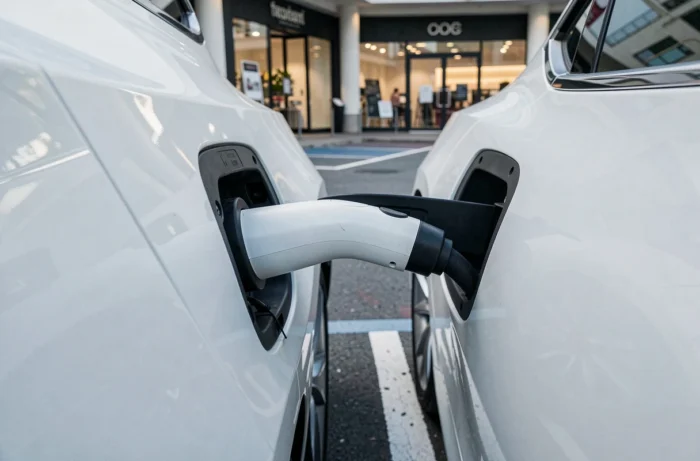
Several Supercharger stations in France now accept electric vehicles from other brands, provided they are equipped with a CCS plug. The station in Arc-sur-Tille, for example, explicitly indicates its openness to compatible non-Tesla vehicles.
In practice, this opening has direct consequences on the charging experience:
- Traffic increases at open stations, especially during peak hours on Friday evenings and during holiday departures. You may find yourself waiting for a free spot where, a few months earlier, the station was deserted.
- Pricing differs depending on whether you are a Tesla driver or not. Owners of other brands pay a higher rate per kWh, without access to the same subscription discounts.
- Not all stations are open: each site has its own access rules. You need to check on the Tesla app or on the onboard map before planning a stop.
For a Hyundai Ioniq 5 or Kia EV6 driver (800 V architectures), the open V4 chargers represent a real power advantage. For a Tesla driver, the opening mainly means a busier network.
Tesla Supercharger pricing in France: variable prices depending on time and status
The price of charging at a Supercharger is not fixed. Tesla applies dynamic pricing that varies according to the time slot and whether you have a subscription to the network.
The price gap between members and non-members is significant. A monthly subscription provides access to a reduced rate per kWh, which becomes cost-effective for drivers who charge regularly while on the road. Without a subscription, the cost per kWh rises, especially during peak demand hours.
This logic of differentiated pricing encourages anticipating your charges. Charging early in the morning or mid-afternoon is cheaper than in the evening during the week. Feedback on this point varies by region, as not all stations apply exactly the same pricing grids.
Comparing with competing networks
Compared to Ionity or Fastned chargers, the Tesla network remains competitively priced for its own customers. For drivers of other brands, the comparison is less favorable once the “non-Tesla” surcharge is added. The choice of network then depends as much on the price as on the location of the chargers along the planned route.
Tesla destination chargers and home charging: two often underestimated pillars
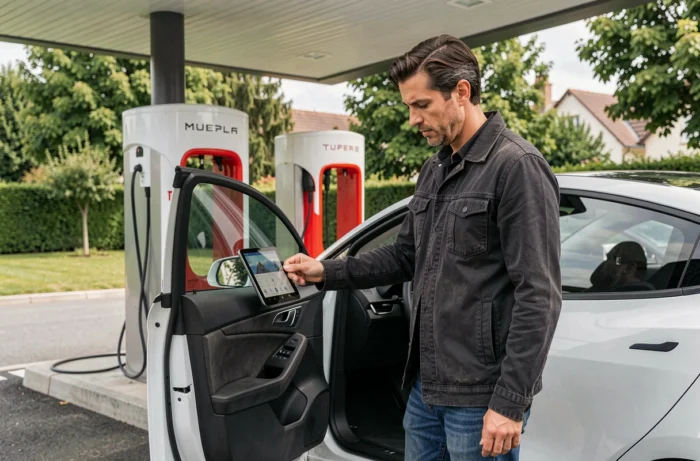
Superchargers capture all the attention, but the majority of daily charges do not take place there. The destination charging network, installed in hotel, restaurant, and shopping center parking lots, offers power up to 22 kW. This is far from fast charging: expect several hours for a significant charge.
This network makes perfect sense during a hotel night or a long lunch. You plug in the car upon arrival, and retrieve it with a full battery without losing any time. This is a very different use from a quick stop on the highway.
Wall Connector at home: the logical complement
For a Tesla owner with a garage or parking space, home charging covers the vast majority of needs. The Wall Connector, installed by an electrician, delivers up to 22 kW in three-phase. A Model 3 can be fully charged overnight.
The Supercharger then becomes reserved for long trips, which completely changes the perception of the network. You are no longer dependent on the availability of public chargers on a daily basis, and the cost of home charging remains well below that of public charging.
MultiPass function and NFC badge: simplifying multi-network access
Tesla has activated a feature in France called MultiPass, which allows the vehicle’s NFC key to be used as a charging badge on multiple partner networks. The idea is to eliminate the need for multiple cards and apps.
In practice, this means you can stop at a compatible charger without pulling out a card or opening a third-party app. The Tesla NFC badge becomes a universal charging pass on the networks integrated into the program. This is a real time saver, especially when making multiple stops on a long trip combining Superchargers and chargers from other operators.
The Tesla network in France continues to expand, with new stations and the gradual arrival of V4 chargers. For a driver who travels a lot, the choice between subscription and pay-per-use, between home charging and on-the-go charging, remains an equation to solve based on actual trips, not the promises of maximum power displayed on a technical sheet.