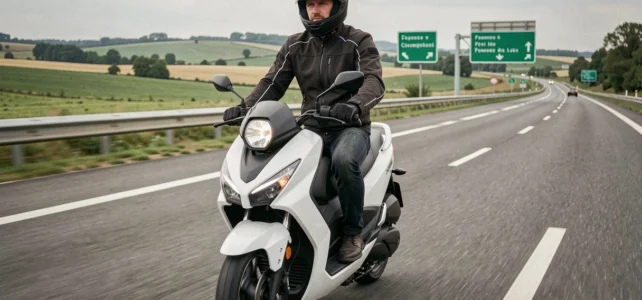
The Yamaha Xmax 125 stands out among the most popular GT scooters in France, and the question of its high-speed behavior comes up in every discussion among owners or potential buyers. With a Blue Core 125 cm3 Euro5+ engine legally capped at 11 kW (15 hp), this scooter can legally access the highway. The reality of its performance at the regulated 130 km/h deserves a more nuanced analysis than the numbers displayed on the speedometer.
Power ceiling of 125 cm3: what the regulations impose on the Xmax
Even before discussing speed, European regulations set the rules of the game. The 125 cm3 scooters accessible with an A1 license or to holders of a B license with a 7-hour training course are limited to 11 kW and a power-to-weight ratio of 0.1 kW/kg. This mechanical ceiling limits the top speed of all 125 GTs, including the Xmax, regardless of the quality of the chassis or aerodynamics.
The Xmax 125’s engine produces its 15 hp and a modest torque transmitted through a CVT variator. The power curve is linear, without any exploitable peak to gain a few extra km/h. To analyze the maximum speed of the Xmax 125 on the highway, one must therefore reason within the strict framework of this regulatory envelope.
In practice, this limitation means that no legal engine preparation will significantly push the ceiling higher. The margin for improvement lies elsewhere: carried weight, rider aerodynamics, and road conditions.
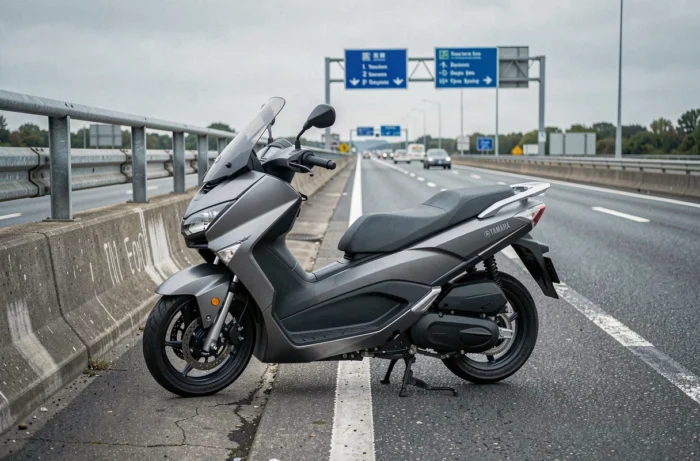
Real speed of the Xmax 125 on GPS: the gap with the speedometer
The speedometer of the Xmax 125 willingly displays peaks close to 120 km/h. This figure is misleading. Yamaha, like most manufacturers, calibrates its speedometers with a deliberate overestimation, particularly pronounced beyond 100 km/h.
GPS measurements reported by users place the real speed between 102 and 112 km/h solo on flat roads, depending on the rider’s weight and weather conditions. Some reports mention GPS peaks of up to 118 km/h under suitable conditions (light rider, slightly downhill road, no wind).
This data changes the perspective. On a highway limited to 130 km/h, the Xmax 125 actually runs 20 to 30 km/h below the flow of traffic. On sections at 110 km/h, the situation becomes more tenable, but the power reserve for overtaking remains very slim.
Usable cruising speed versus top speed
Recent tests emphasize a nuance rarely addressed: the theoretical top speed is not one that can be maintained for long without excessively stressing the engine. A run-in Xmax 125 is better utilized around a stable speedometer reading of about 110 km/h solo on flat highways.
Beyond that, the engine operates at full load continuously. The mechanics can handle it, but fuel consumption rises, and the ability to react (acceleration for overtaking or merging) becomes almost nonexistent. Maintaining maximum speed over a long journey makes little sense in terms of comfort or long-term reliability.
Xmax 125 two-up on the highway: the real performance loss
This is one of the least documented points by manufacturer specifications. Carrying a passenger and luggage radically changes the behavior of the Xmax 125 at high speed.
Recent field reports indicate a typical drop of 15 to 20 km/h in top speed when two-up with luggage compared to solo riding. In real conditions, this brings the scooter to GPS speeds close to 90 to 100 km/h. On a highway at 130 km/h, the safety margin becomes insufficient for riding calmly with the flow.
The consequences go beyond the simple question of speed:
- The ability to overtake almost completely disappears, making merging and lane changes risky against vehicles traveling at 120 km/h and above.
- Braking distances are extended due to the additional mass, while safety distances with faster vehicles are reduced.
- Aerodynamic stability deteriorates, with the passenger increasing lateral wind resistance and turbulence caused by heavy vehicles.
Two-up, the Xmax 125 remains suitable for expressways limited to 90 km/h and national roads. The highway at 130 km/h with a passenger is more about survival than comfort.
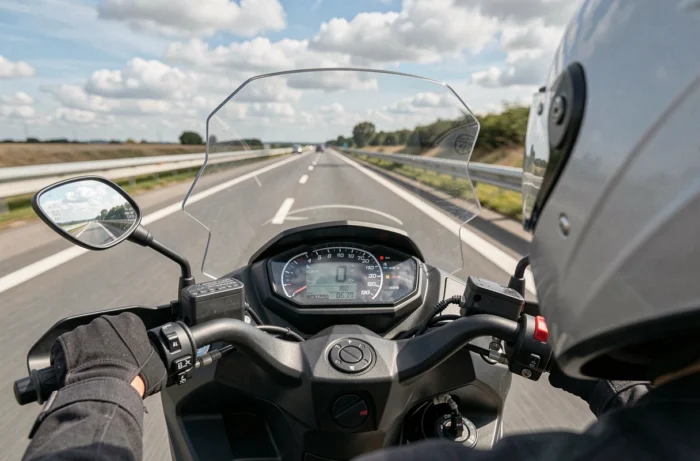
Riding on the highway with the Xmax 125: the parameters that change everything
Beyond the carried weight, several factors directly influence usable speed and safety.
Headwinds are the primary enemy. A strong headwind can subtract about ten km/h from cruising speed, placing the scooter in a dangerously low speed zone compared to highway traffic. Field reports vary on this point, with some riders reporting more pronounced drops depending on their physique and riding position.
The condition of the tires and inflation pressure also play a measurable role. Under-inflated tires increase rolling resistance and reduce top speed by a few km/h, in addition to degrading handling at high speeds.
The engine break-in influences initial performance. A new Xmax 125 will not immediately reach its suitable top speed. Available data suggests that the engine gains flexibility and extension after several thousand kilometers, without drastically changing the baseline figures.
Highway or expressway: choosing the right route
The most pragmatic question is not whether the Xmax 125 can ride on the highway, but whether it should. On sections at 110 km/h (some highway portions, expressways), the scooter maintains its position in the flow without too much difficulty when solo. On stretches at 130 km/h, it becomes the slowest vehicle, which generates stress and increases risk.
- Expressways at 110 km/h are the natural terrain for the Xmax 125 for quick trips.
- Highways at 130 km/h remain legally accessible, but caution dictates staying in the right lane and avoiding heavily trafficked sections with trucks.
- GPS applications offering alternative routes often allow for bypassing the most exposed sections, with sometimes minimal travel extension.
The Xmax 125 was not designed as a highway cruiser. Its area of excellence remains suburban and intercity connections at moderate speeds. On the highway at 130 km/h, it meets legal requirements without offering the safety margin of a 300 cm3 or a motorcycle. Choosing routes with full awareness remains the best guarantee for riding both fast and safely.