
A perfectly round peony bouquet can look dull without the right foliage around it. It is the leaves, branches, and green stems that create depth, movement, and contrast in a floral arrangement. Choosing your foliage carefully can radically change the final result, sometimes even more than the choice of flowers themselves.
Texture and volume of foliage: two criteria before color
You may have noticed that a bouquet made solely of roses and eucalyptus looks completely different from the same bouquet with ferns instead? The difference lies in the texture. Smooth, rounded foliage like that of pittosporum provides a compact and structured effect. A fern, with its cut fronds, opens up the composition and gives it air.
Before thinking about colors, ask yourself about the desired texture. A matte foliage absorbs light, while a glossy foliage reflects it. The leathery leaves of aspidistra or laurel create a dense, almost architectural background. In contrast, ornamental grasses or cascading jasmine introduce movement and lightness.
Volume works in the same way. Branches of branched olive occupy a lot of space with little material. A bouquet of ruscus, on the other hand, forms a tight green cushion. To find the ideal foliage for floral composition, start by determining whether your arrangement needs to be airy or dense.
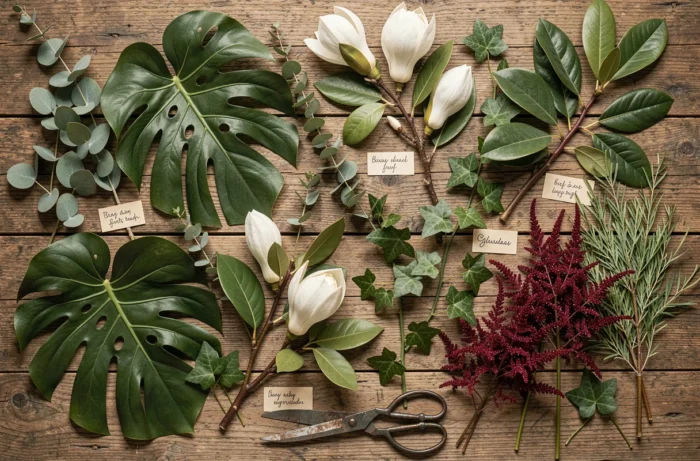
Seasonal foliage: why availability changes everything
Professional florists do not work with the same foliage in February and July. The season dictates what is fresh, supple, and durable in a vase. Ignoring this factor risks having foliage that wilts in two days or that arrives already yellowed.
Spring and summer: the freshness of tender foliage
In spring, young beech or viburnum shoots offer a tender, almost translucent green. This foliage is fragile but brings a freshness that nothing else can imitate. In summer, ivy, pittosporum, and mint (yes, mint) hold up well in the heat and subtly scent the room.
Autumn and winter: branches and evergreen foliage
Evergreen foliage like eucalyptus or ruscus is available all year round. In autumn, branches of cotinus or red oak add copper tones without resorting to expensive flowers. In winter, noble fir, cedar, and holly structure compositions with remarkable vase life.
Working with the season also reduces the ecological footprint of your creations. Foliage imported out of season often undergoes heavy phytosanitary treatments to meet import controls, which affects their freshness and longevity.
Combining foliage and flowers: three combinations that work
Rather than listing twenty possible combinations, here are three proven combinations that cover very different styles. Each is based on a specific principle.
- Eucalyptus cinerea and white roses: the gray-blue foliage of eucalyptus creates a soft contrast with white. The effect is romantic without being sweet, perfect for wedding decor or a sleek centerpiece.
- Fern and dahlias: the fine fronds of the fern contrast with the dense roundness of the dahlia. This combination plays on the opposition of textures, with the foliage being almost as expressive as the flower.
- Olive branches and sunflowers: the silvery foliage and woody stems of the olive bring a rustic structure. Paired with sunflowers, the result evokes Provence without artifice.
In each case, the foliage represents half or more of the total volume. A foliage-flower ratio of 50/50 to 60/40 generally results in more natural compositions than a bouquet where the leaves serve as mere filler.

Floral compositions without foam: foliage as structure
Recent trends in floral art are moving away from synthetic foam (like Oasis) for ecological reasons. Foliage then takes on an additional role: that of framework. Rigid branches of myrtle or dogwood can replace floral foam by creating a natural mesh in which the flower stems are anchored.
This technique requires foliage with strong, branched stems. Ruscus, with its small, sturdy leaves and flexible yet firm branches, works particularly well. Several stems are intertwined at the bottom of the vase to form a green grid.
This process offers a concrete advantage: structural foliage extends the life of the bouquet because it keeps each stem in place without compressing the bases. The flowers absorb water better and maintain their natural posture longer.
Common mistakes in choosing foliage for bouquets
Some mistakes often recur, even among experienced amateurs.
- Using a single type of foliage throughout the arrangement. Two or three complementary varieties create a depth that single-foliage cannot achieve.
- Neglecting submerged lower leaves. Any leaf below the waterline must be removed, otherwise it rots and contaminates the vase within hours.
- Choosing overly fragrant foliage. Eucalyptus or mint release strong aromas that can overpower the scent of the flowers, or even be bothersome in a closed space.
- Forgetting to recut the stems of the foliage. As with flowers, a diagonal cut when placing in the vase improves water absorption.
Foliage deserves the same attention as flowers in a composition. When well chosen, it transforms a decent bouquet into a memorable arrangement. Poorly matched or poorly prepared, it drags the whole down, even with the most beautiful flowers on the market.