
Moving from row 12 to row 14 without transition, looking for a seat B on the ticket without finding it on the cabin plan: these numbering anomalies regularly surprise passengers. Behind these choices lie logics that mix superstition, marketing, and operational flight management.
Airlines and row 13: who keeps it, who removes it
The removal of row 13 does not follow any international standard. Each airline decides on its own cabin numbering. The result is a patchwork where two identical aircraft can display different seat maps depending on the logo painted on the fuselage.
| Airline | Row 13 | Note |
|---|---|---|
| United Airlines | Absent on some aircraft | Variable policy depending on the fleet |
| Lufthansa | Absent | Also removes row 17 on some planes |
| Delta Air Lines | Present | Maintained on several configurations |
| British Airways | Present | No removals reported |
| American Airlines | Present | Kept on the majority of the fleet |
The table shows a clear divide between continental European and Anglo-Saxon airlines. Lufthansa goes further than its competitors by also removing row 17, a number considered unlucky in Italy and Brazil. This approach targets markets where these cultural beliefs remain strong.
To understand the reasons behind these numbering choices, particularly seat B and row 13 on airplanes raise questions that go beyond simple superstition and touch on the very design of cabins.
Row 17 and other banned numbers: superstitions vary by country
Narrowing the issue down to just the number 13 would be misleading. Airlines adapt their numbering to the cultural sensitivities of their main clientele, not to a universal fear.
- In Italy and Brazil, 17 is associated with bad luck. In Roman numerals, XVII can be rearranged to VIXI, which means “I have lived” (thus “I am dead”) in Latin.
- In East Asia, the number 4 is problematic: its pronunciation in Mandarin, Cantonese, and Japanese is close to the word “death.” Some Asian hotels eliminate floors 4, 14, and 24.
- 13 concentrates distrust in Western Europe and North America, linked to Christian traditions (13 diners at the Last Supper) and Nordic beliefs.
Superstition is never monolithic: it depends on the target customer base. An airline whose flights connect Frankfurt to São Paulo has an interest in removing 13 and 17. An airline that mainly operates domestic routes in the United States can keep 13 without measurable impact on its bookings.
Seat B on airplanes: an absence related to cabin configuration, not superstition
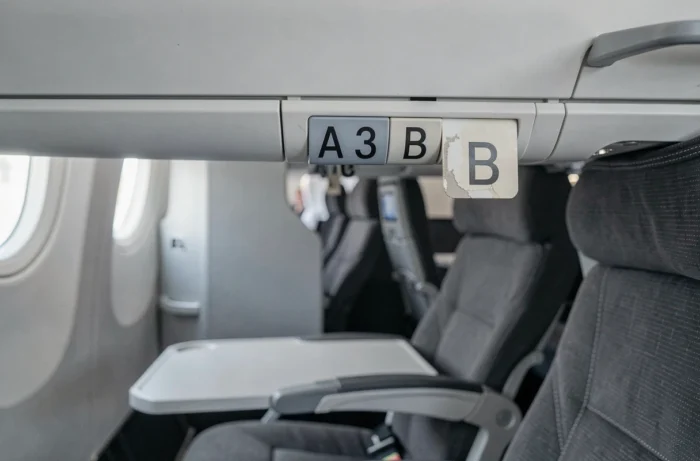
The mystery of seat B stems from a completely different logic. In 3-3 configurations (three seats on each side of the aisle), the letter B designates the middle seat on the left side. It exists and appears on the plan.
However, in narrower configurations (2-2 or 2-3), the letter B disappears because the physical column does not exist. Airlines apply an international lettering standard: A and F designate the windows, C and D the aisle seats. When there are only two seats per row on one side, it goes directly from A to C.
This convention avoids confusion during connections. A passenger accustomed to booking an A seat knows they will always be by the window, regardless of the aircraft. The lettering does not follow the alphabet but the physical position in the cabin.
When seat B becomes an asset
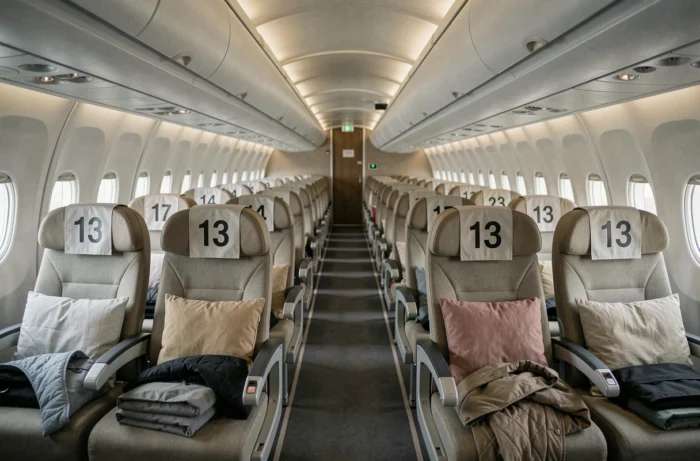
On large aircraft configured in 3-4-3 or 3-3-3, seat B is indeed present. In some recent configurations, row 13 (when maintained) coincides with an area where the spacing between rows slightly increases, near the emergency exits. The “cursed” seat can then offer legroom above average.
Passengers who avoid these seats out of superstition sometimes leave empty seats in comfortable areas. For pragmatic travelers, it’s a boon when selecting a seat.
Managing the customer experience: why airlines yield to superstition
Removing a row number costs an airline nothing. The total number of seats remains the same; only the label changes. However, keeping an anxiety-inducing number generates concrete operational frictions: requests for seat changes at the counter, stress during boarding, complaints after the flight.
The decision is therefore purely commercial. Airlines that remove 13 do not believe in the curse of the number. They calculate that the cost of renumbering (almost zero) is less than the cost of handling complaints and reassignment requests.
This approach is part of a broader trend of optimizing the passenger experience. Seat numbering, cabin color, ambient lighting: every detail aims to reduce flight anxiety. The removal of 13 is a tool for managing passenger stress, not a superstitious act.
Low-cost airlines, whose model relies on quick boarding, have even less interest in creating friction points. A row that no one wants to occupy slows down the flow in the aisle.
Ultimately, row 13 and seat B tell the same story from two opposing angles. One disappears by commercial calculation, the other by physical constraint. In both cases, the numbering of an airplane cabin is anything but trivial: it reflects the beliefs of passengers as much as the architecture of the aircraft.