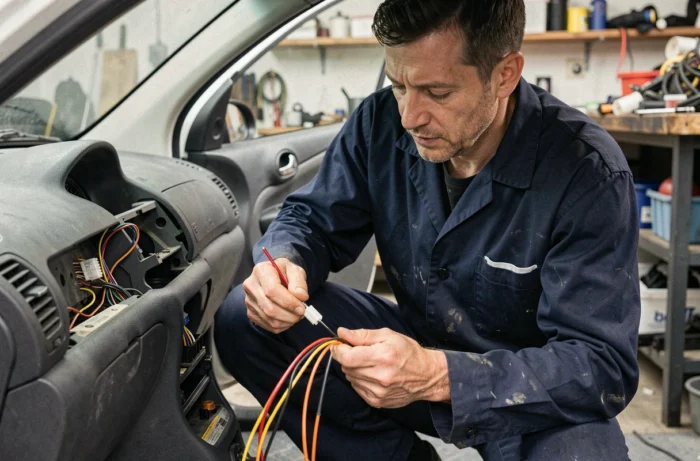
You have removed the dashboard of your Peugeot 206 or 207 to replace the original radio, and you come across a cluster of wires with colors that do not match any diagram found online. The problem rarely stems from your incompetence: the colors on the Peugeot vehicle side do not always follow the ISO standard on the radio side. Understanding this distinction prevents short circuits, silent speakers, and hours wasted searching for a fault that does not exist.
Peugeot side wire and radio side wire: two distinct color logics
When discussing the color code of radio wires, two things are often mixed up. On one side, the ISO standard assigns fixed colors to the wires of the new radio you just purchased. On the other side, Peugeot uses its own color code in the vehicle’s wiring harness.
The yellow wire from your aftermarket radio corresponds to +12 V permanent (direct power from the battery). The red wire corresponds to +12 V after ignition (power cut when the key is removed). The black wire is the ground. These three colors are almost universal on the radio side.
On the Peugeot 206 side, the wires in the original connector do not necessarily have these same colors. This is where an ISO adapter harness makes perfect sense: it translates between the Peugeot color code and the standard color code. Adapters from brands like ACV or tomzz Audio clearly indicate the correspondence, making generic color guides less reliable than a good adapter plugged directly in.
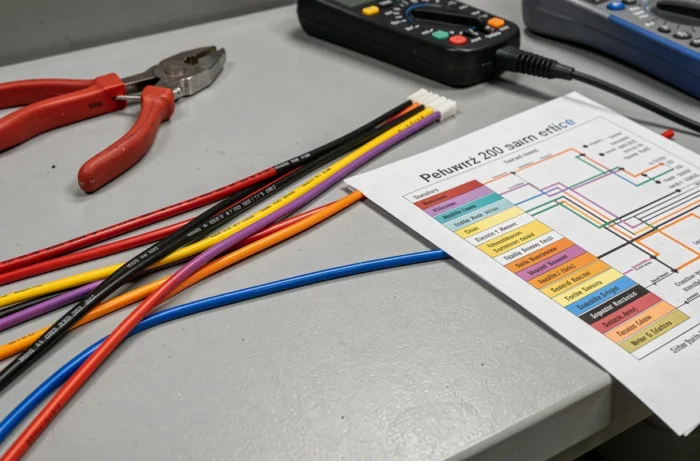
Finding the color code for Peugeot 206 and 207 radio wires on a dedicated diagram is useful for checking your installation, but the adapter harness remains the safest method.
ISO connector on Peugeot 206: still a straightforward wiring
The 206 is one of the last Peugeot models where the connection remains relatively simple. No CAN network to manage on the older versions. The original connector accepts a standard ISO adapter, and the power wires physically reach the socket.
Power and ground on the 206
You will find a wire for +12 V permanent, a wire for +12 V after ignition (ACC), and a ground wire. On the 206, the ACC wire physically exists, which means that the radio does turn off when you cut the ignition. No additional interface is needed for this function.
Front and rear speaker wires
The four speakers (two front, two rear) are connected by pairs of wires: one positive and one negative for each speaker. On the new radio side, the colors are standardized:
- White and white/black for the left front speaker
- Gray and gray/black for the right front speaker
- Green and green/black for the left rear speaker
- Purple and purple/black for the right rear speaker
The wire striped with a black band is always the negative of the pair. Reversing positive and negative on a speaker does not blow anything, but creates an acoustic phase shift: the sound seems hollow and lacks bass.
Peugeot 207 and CAN network: why the connection gets complicated
The 207 marks a technical break from the 206. On versions equipped with an RD4 radio or a multiplexed system, the BSI (intelligent service box) controls the power to the radio via the CAN bus. Have you ever noticed that a new radio lights up but produces no sound on a 207? This symptom almost always comes from there.
Without a CAN-bus interface, the radio does not receive the command to activate even if the power wires are correctly connected. The current flows, the screen lights up, but the BSI does not send the wake-up signal to the unit. Result: no sound, steering wheel controls inoperative, and sometimes a reboot loop.
The case of Android radios on the 207
The installation of Android radios has exploded in recent years on the 206 and 207. The recurring problem reported by users concerns a very low or “flat” sound on 207s equipped with the original amplifier. The Android radio sends the audio signal as if the speakers were passive, while the vehicle has a built-in amplifier that expects a control signal.
The remote wire (blue or blue/white on the radio side) must then be connected to the control wire of the original Peugeot amplifier, via a specific adapter. Without this connection, the volume remains anemic regardless of the setting.
Check your connection with a multimeter before powering on
Before reconnecting everything and turning on the ignition, a quick check with a multimeter avoids unpleasant surprises. The procedure takes a few minutes and only requires a basic device.
- Check the voltage on the permanent wire (yellow on the radio side): you should read about 12 V even with the ignition off
- Check the ACC wire (red on the radio side): the voltage should only appear with the ignition on
- Check the continuity of the ground (black wire): the resistance should be close to zero ohms to a bare body point
- Test each pair of speaker wires in continuity mode to detect any short circuit between positive and negative
Testing before connecting protects the radio and the speakers. An inverted permanent wire and ACC wire do not immediately blow the unit, but the radio will never turn off with the ignition, draining the battery in a few days.
ISO adapter harness for Peugeot: what changes between 206 and 207
For the 206, a basic ISO adapter is sufficient in most cases. It converts the original Peugeot connector to the standard ISO socket, wire by wire, without any built-in electronics.
For the multiplexed 207, a CAN-bus interface adapter is required. This box decodes the signals from the CAN network to simulate the presence of the original radio to the BSI. It also manages the return of steering wheel controls to the aftermarket unit.
Confusing the two types of adapters is the most common mistake. A passive adapter on a 207 CAN will give exactly the symptoms described above: screen on, no sound, dead controls. The price of a CAN-bus adapter remains modest compared to the time lost searching for a wiring fault that does not exist.