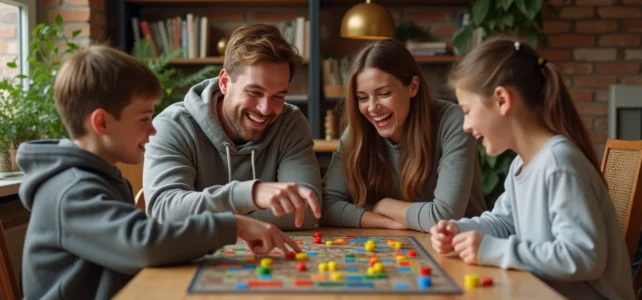
A rainy Sunday, four people around a table, and the board game taken out of the cupboard falls apart. The cards stick, the hourglass is broken, and two pieces are missing. This kind of situation turns a good idea into collective frustration. Before searching for the perfect game, it’s worth questioning what truly makes a game enjoyable for the whole family, accessories included.
Family Game Accessories: What Really Changes the Game
There’s a lot of talk about titles, mechanics, and themes. But the quality of a game night also depends on the peripheral equipment. A deck of cards handled by children’s hands wears out quickly. Card protectors suited to the game’s format extend the lifespan by several years.
Card holders for younger players address a concrete problem: a five or six-year-old struggles to hold a fan of seven cards without showing them to everyone. This small accessory, often sold for a few francs, eliminates a source of conflict and allows the youngest to play independently.
On the storage side, custom box inserts (made of foam or wood) reduce setup time. When you have forty minutes before dinner, losing ten minutes sorting loose tokens in a plastic bag eats up a quarter of the available time. A good selection of games and suitable accessories can be found at u-games.ch, especially for common family formats.

Family Card Games: The Format Dominating the Segment
Compact card games have overtaken large board games in the family segment in recent years. The reason is practical: a box of cards fits in a bag, can be taken on vacation, and is stored in thirty seconds.
Reimagined trick-taking mechanics work well with players of varying ages. An eight-year-old understands the principle of “playing higher” or “cutting” in one round. Micro-deckbuilding games (where players build their hand throughout the game) add a layer of decision-making without extending the duration beyond twenty minutes.
Criteria for Choosing a Family Card Game
- The announced game duration: under thirty minutes, allowing for two rounds without fatigue, which suits children with shorter attention spans
- The minimum number of players: a game that works with two players also allows for parent-child duels during the week, not just large gatherings on weekends
- The readability of the cards: clear icons and limited text prevent the need to reread the rules every turn, especially for beginner readers
Hybrid Toys and Connected Games: Where to Draw the Line
Manufacturers of connected toys (programmable robots, interactive learning games, objects compatible with a mobile app) face increasingly strict regulations on data privacy and child safety. Data collection, geolocation, audio recording: regulatory pressure pushes to limit unnecessary connected features.
The result for families is the emergence of hybrid toys. The digital aspect remains in the background: a companion app unlocks occasional content, but the game works perfectly without a screen. This compromise appeals to parents who want to avoid extra screen time without giving up a touch of modernity.
What to Check Before Buying a Connected Game
We check whether the game requires a permanent connection or if the app is optional. A toy that becomes unusable when the manufacturer’s server shuts down has no longevity. Feedback varies on this point depending on the brands, but the trend clearly leans towards products that remain playable offline.
We also check the permissions requested by the app. Microphone, camera, location: if these accesses do not correspond to any visible game function, it’s a warning sign.

Adapting Game Choices to Family Configuration
A family with a four-year-old and a fourteen-year-old does not have the same options as a household with three children of the same age. The real selection criterion is the age gap between players, not the number of people around the table.
When the gap exceeds five or six years, cooperative games solve part of the problem. Everyone plays against the game’s mechanism, not against each other. The older child can guide without it feeling like a private lesson, and the younger one genuinely contributes to the decisions.
For closely-aged siblings, dexterity or speed games (stacking, grabbing, pattern recognition) level the differences. An adult does not necessarily have better reflexes than a seven-year-old in this type of mechanic, which rebalances the competition.
- Significant age gap: favor cooperative games or games with built-in handicaps (asymmetrical roles, variable difficulty levels)
- Close siblings: speed and observation games create rounds where everyone has a real chance
- Only two players: strategic duel games (cards, abstract) offer a depth that large multiplayer games do not reach in a reduced setup
The material matters as much as the chosen title. A well-organized game, with accessories in good condition, gets played more often than a damaged box stuck at the back of a shelf. Investing a few minutes in maintenance and storage ensures that the next game night starts smoothly, cards in hand, dice on the table.