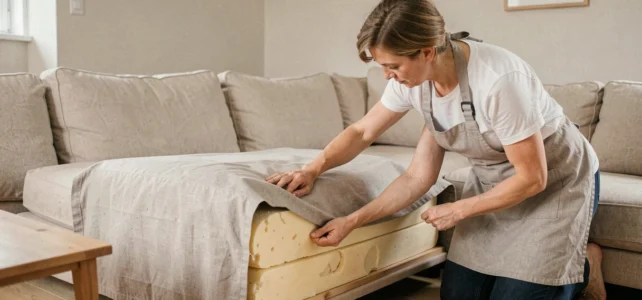
The foam of a Poltronesofa sofa eventually collapses after several years of daily use. Before ordering a foam block and disassembling the seat, a few technical mistakes can turn this operation into an expensive failure. Identifying these pitfalls in advance helps avoid damaging the sofa or spending money for a temporary result.
Check the structure before changing the Poltronesofa foam
The most common reflex is to directly blame the foam when the seat sinks. Field feedback shows that the foam is not always the real cause of the sagging. Loose elastic straps, broken slats, deformed suspension: these supporting elements play a direct role in maintaining the seat.
If the structure is faulty, new foam will degrade within a few months. The weight of the body will no longer be distributed correctly, and the new foam will experience abnormal stress in the same areas.
Before investing in foam replacement, turn the sofa over. Check the condition of the straps, springs, or wooden frame. If you notice play, creaking, or visible deformation, the problem lies beneath the foam. When considering replacing the foam of a Poltronesofa sofa, this prior diagnosis makes all the difference between a successful renovation and a failure.
Foam density: the trap of confusing it with firmness
Density, expressed in kg/m³, measures the amount of material in a given volume of foam. It determines the lifespan of the block. Firmness, on the other hand, only describes the sensation to the touch, whether the seat feels soft or hard when sitting down.
A foam may feel firm in the store while having a low density. In this case, it will collapse quickly under repeated use. Conversely, a dense foam can offer a plush feel while maintaining its shape for years.
What this changes for replacement
When ordering replacement foam, many individuals choose based on the comfort felt when pressing the block by hand. This test only informs about firmness. Only density guarantees the longevity of the foam.
For a sofa seat used daily, the foam must reach a sufficiently high density threshold. Cheap blocks sold in supermarkets or online often have densities that are too low for intensive use. The filling then loses its volume within a few months, reproducing exactly the initial problem.
Measuring and cutting foam: common mistakes
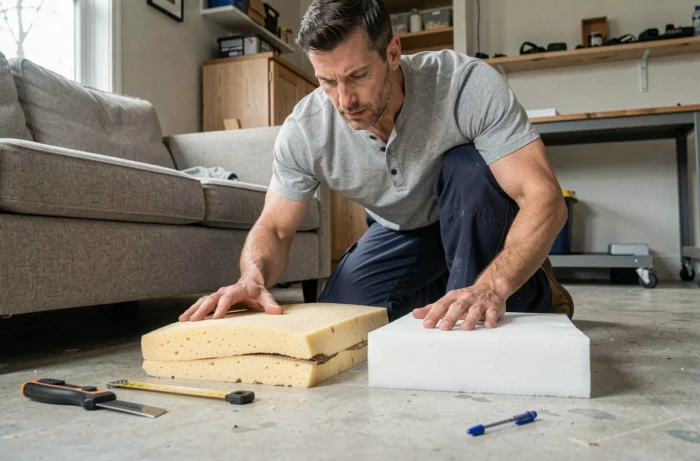
Not all Poltronesofa sofas have standard rectangular seats. Some models incorporate rounded shapes, specific angles, or varying thicknesses between the front and back of the cushion. An approximate measurement produces a block that floats in the cover or bulges unattractively.
- Measure the length, width, and thickness directly on the old foam removed from its cover, not on the cover itself which may be deformed from use.
- Identify specific cuts: bevels, chamfers on the front edges, notches to fit the sofa frame.
- Check if the original seat had several glued layers (high resilience foam at the base, memory foam on the surface) rather than a single block.
Reproducing the original multilayer structure is often overlooked by individuals who order a single homogeneous block. The result radically alters the comfort and sinking compared to the original sofa.
Legal warranty and Poltronesofa customer service: a lever before any intervention
Dismantling a sofa still under warranty can forfeit any recourse. In France, the legal warranty of conformity requires the seller to cover repair or replacement at no cost if the defect existed at the time of sale. This particularly covers premature sagging of the foam, a sign of a quality defect in the filling.
If the repair proposed by customer service fails or takes an unreasonable amount of time, the consumer can then request a price reduction or a refund. Taking action oneself before activating this lever means giving up on a remedy that costs nothing.
When home intervention becomes relevant
Home replacement is justified in two specific cases:
- The sofa is out of warranty and Poltronesofa customer service does not offer a satisfactory solution.
- The model is several years old and consumer feedback indicates long processing times, with photo arbitration sometimes unfavorable.
- The cost of a professional intervention exceeds the residual value of the sofa, which frequently happens with entry-level models.
In these situations, replacement by an individual remains the most economical solution, provided that the technical points mentioned above are respected.
The most costly trap remains replacing a component without having identified the real cause of the problem. A complete diagnosis of the structure, a choice of foam based on density and not touch, and checking your rights with the seller transform a risky operation into a sustainable renovation.