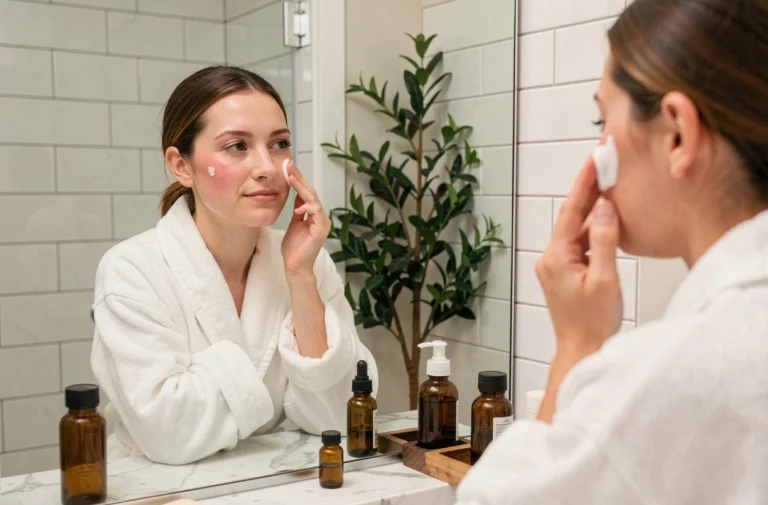
The first white hairs on a brown mane create a stark, almost binary contrast. White stands out against dark brown much more than against a blonde or light brown base. Covering this contrast with classic coloring every month ultimately damages the hair fiber and burdens the budget. Grey blending for brunettes offers a different approach: instead of masking the white, it gradually integrates it into the overall hair for a natural blend.
Why the brown base complicates the transition to grey hair
Have you ever noticed that white hairs appear more visible on a brown head than on a blonde one? The reason is purely optical. Brown absorbs light, while white reflects it. The contrast between the two is maximal.
This discrepancy poses a concrete technical problem. Natural brunettes often lean towards warm tones (chocolate, hazelnut, mahogany). White hairs, on the other hand, are cool by nature since they no longer contain melanin. When trying to mix these two color temperatures without preparation, the grey strands stand out like isolated filaments in the brown mass.
That’s why specialized colorists recommend cooling the brown base before any intervention. Specifically, the existing color is adjusted to an ash brown or ash. This pre-neutralization step allows future grey strands to blend into a compatible chromatic environment. Without this preparation, which specifically concerns the grey blending transition for brunettes, the result lacks harmony, regardless of the hairdresser’s talent.
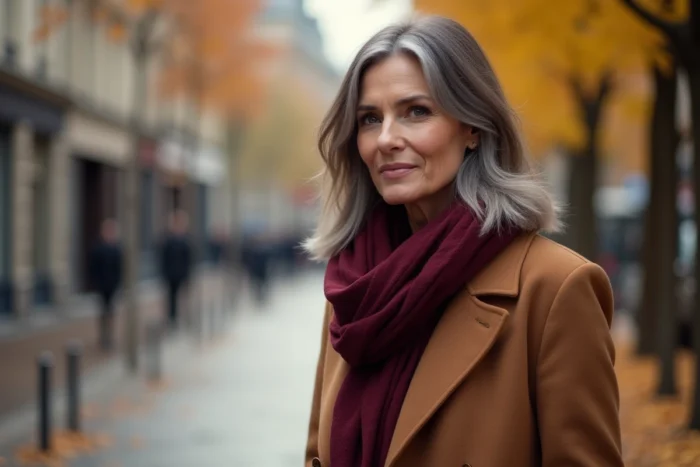
Grey blending protocol for brunettes: the steps over several months
Grey blending on brown hair is not limited to a single session in the salon. Recent professional content describes it as a structured support, spread over several months.
The diagnostic phase
The hairdresser first allows the natural roots to grow out a few centimeters. This regrowth allows for an assessment of the actual percentage of white hairs and their distribution on the scalp. A woman whose temples turn white first will not have the same plan of action as a woman whose white appears diffusely.
The technical balayage
Once the mapping is established, the colorist applies fine calibrated strands to reproduce the salt-and-pepper effect of the roots throughout the hair. On a brown base, this balayage generally uses cool shades (ash, smoky, pearl grey) rather than golden or coppery highlights.
The work is done by zones. Areas where natural white is concentrated receive fewer strands. Areas that are still highly pigmented receive more. The goal is to erase the demarcation line between white roots and colored lengths.
Follow-up appointments
Unlike a covering color that requires a salon visit every three to four weeks, grey blending spaces out the appointments. The regrowth no longer creates a visible line since the white roots have already been integrated into the overall design. However, the protocol provides for regular adjustments during the transition phase to refine the blend as new white hairs appear.
- First session: neutralization of the warm base and application of the first cool strands on the most contrasted areas.
- Intermediate sessions (spaced several weeks apart): gradual extension of the balayage into still pigmented areas, adjustment of the color temperature.
- Maintenance phase: occasional touch-ups, mainly with a purple or silver shampoo to prevent yellowing of the light strands.
Maintenance of grey hair on a brown base: what changes daily
Once the transition begins, the hair care routine evolves. White hair has a different texture from pigmented hair. It is often thicker, drier, and sometimes more unruly. On a brown mane in full transition, you end up with two types of fibers coexisting.
The products to prioritize are those that hydrate without weighing down. Dehydrated white hair yellows faster and loses its silver shine. Treatments formulated for natural or colored grey hair generally contain purple or blue pigments that neutralize yellow undertones.
Purple shampoo, used once or twice a week, remains the basic gesture. It does not color: it deposits a veil of cool pigment that counteracts natural oxidation. On a brunette in grey blending, this shampoo mainly acts on the lightened strands and the white hair, without altering the remaining dark base.
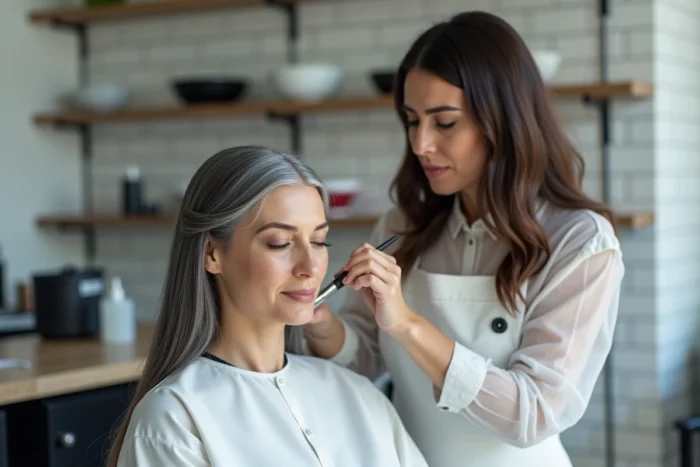
Grey blending for brunettes and classic coloring: two opposing philosophies
Covering color is based on the principle that white hair is a problem to be masked. An opaque pigment is applied to the entire mane, including the roots. The result is uniform but temporary. As soon as regrowth appears, the contrast returns.
Grey blending starts from the opposite principle: white hair is part of the final result. It is not hidden; it is built around. For a brunette, this change in perspective alters the entire relationship with the appearance of white hair.
- Fewer salon visits throughout the year, as regrowth integrates instead of contrasting.
- Fewer chemicals applied to the scalp, as the technique works with fine strands rather than a global color bath.
- A result that evolves with the natural hair instead of freezing an artificial state.
This approach, however, requires patience. The transition phase lasts several months, sometimes close to a year for very dark brunettes whose initial contrast is marked. During this period, the result is under construction. One must accept a “moving” mane before reaching the final blend.
For brunette women who are still hesitant, the question simply arises: continue to color every month while fighting against regrowth that always returns, or invest a few months in a transition that makes each new regrowth compatible with the whole. Grey blending does not eliminate white hair. It changes the way they appear in the hair, and for brunettes, this difference is radical.