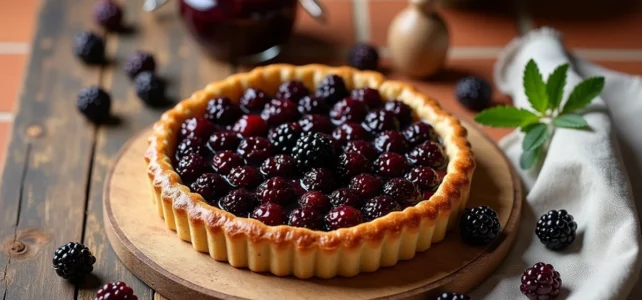
The mulberries from the plane tree ripen in just a few days, fall to the ground, and stain everything they touch. You may have one of these trees in your garden or on your street, and every summer the same question arises: what to do with these sweet little fruits before they end up squashed on the sidewalk?
These berries, quite different from the bramble blackberries picked from hedges, offer a tender, very juicy flesh, with a sweetness reminiscent of figs. They deserve much better than to be forgotten.
Plane tree mulberries and bramble blackberries: what’s different in the kitchen
Before pulling out the pots, one point needs clarification. The bramble blackberry (the one from hedges, genus Rubus) and the mulberry from the plane tree (genus Morus) behave very differently once harvested.
The bramble blackberry is tart, firm, and holds up well to long cooking. The plane tree mulberry is much sweeter and more delicate. It crushes easily between your fingers, releases its juice quickly, and oxidizes within a few hours at room temperature.
This fragility has a direct consequence on your recipes: plane tree mulberries require less added sugar, shorter cooking times, and gentle handling. When adapting a recipe using plane tree mulberries, keep this rule in mind: the less you cook, the more you preserve their sweet flavor and color.
Another notable difference: the white mulberries from the tree (Morus alba, the most common variety on plane trees) have a milder taste than the black ones (Morus nigra). The white ones work well mixed with more acidic fruits, while the black ones are sufficient on their own.
Mulberry jam: short cooking and melting texture
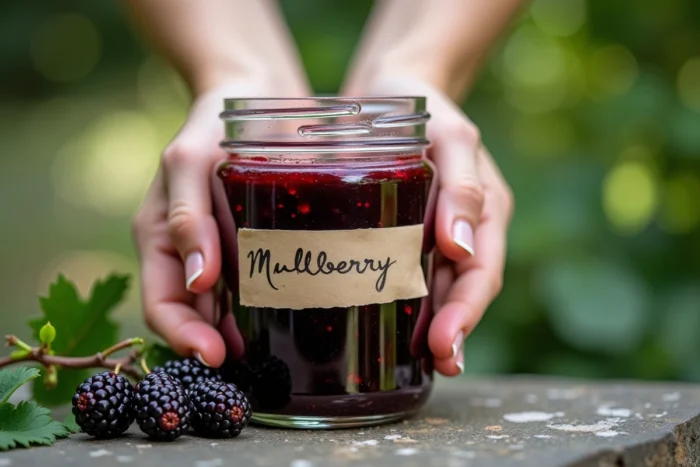
Jam is the first idea that comes to mind, and for good reason. With such sweet mulberries, the result is generous without needing to drown the fruit in sugar.
Proportions and method
The principle is simple: reduce the amount of sugar compared to a classic jam. Where a strawberry jam often requires a 1:1 ratio (equal weight of fruit and sugar), plane tree mulberries can handle a 2:1 ratio (two parts fruit to one part sugar). The fruit already brings a marked natural sweetness.
- Quickly wash the mulberries under a stream of cold water, without soaking them, to avoid saturating them with water.
- Mix them with sugar in a jam pot and let them macerate for an hour. The juice will rise on its own.
- Cook over high heat for about fifteen minutes, no more. The goal is to keep melting pieces rather than a uniform paste.
- A splash of lemon juice at the end of cooking enhances the flavor and helps with setting, as these mulberries contain little natural pectin.
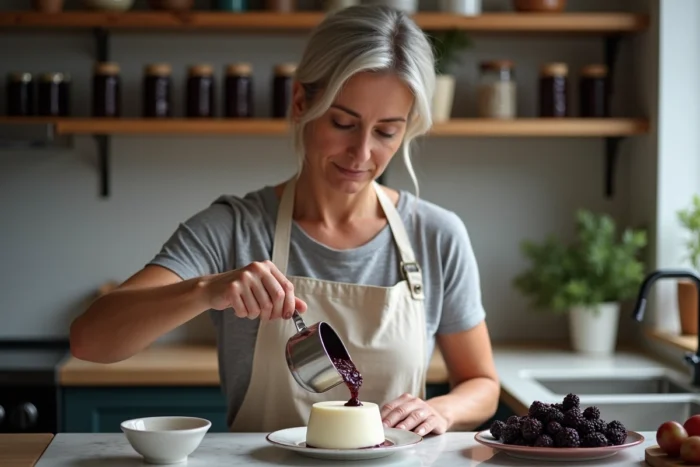
You get a runny jam, almost a thick coulis, that can be spread but also poured over yogurt or panna cotta.
Tip for preservation
The low acidity of white mulberries makes sterilizing jars more important than for a gooseberry jam. Turn your jars upside down as soon as they are filled and let them cool upside down. If you use black mulberries, their slightly higher acidity makes preservation easier.
Mulberries in pastry: tart, clafoutis, and crumble
In pastry, these mulberries pose a challenge you may have already encountered: they release a lot of juice during cooking. A classic tart base becomes soggy in less than twenty minutes.
Protected tart base
The solution is to blind-bake the crust before adding the fruit. Roll out your shortcrust or sweet pastry, prick the bottom, cover with baking beads, and bake for about ten minutes. Once the base is golden, sprinkle a thin layer of almond flour before adding the mulberries. The almond absorbs the excess juice and adds a subtle nutty flavor that pairs well with the sweetness of the fruit.
Quick clafoutis
The clafoutis is perhaps the most forgiving recipe for these mulberries. The batter (eggs, flour, milk, sugar) coats the fruits and captures all the juice. No need for pre-baking or special technique. Place the mulberries in a buttered dish, pour the batter over them, and bake. The cooking takes about thirty minutes at moderate heat.
The crumble works on the same principle. The layer of sweet pastry on top absorbs the juice while remaining crispy if you sprinkle it with oats.
Mulberry sorbet and coulis without cooking
Don’t feel like turning on the oven in the middle of summer? Raw preparations highlight the delicate flavor of these mulberries, which heat tends to uniformize.
Homemade sorbet
Blend the mulberries, strain them to remove the small seeds, add a light syrup (water and sugar brought to a boil and then cooled) and a splash of lemon. Pour into an ice cream maker or, if not available, into a container in the freezer, stirring with a fork every hour. The result is a deep purple sorbet with a flavor close to figs.
Coulis for desserts and cocktails
The coulis is even quicker to prepare: blended mulberries, strained, sweetened to your taste. It pairs well with a cheesecake, can be added to a glass of prosecco, or replaces syrup in homemade lemonade. Store it in the refrigerator; it lasts two to three days without issue.
Harvesting and preservation: don’t miss a season of mulberries
The harvesting window on a plane tree is short. The fruits ripen in waves over a few weeks, and each mulberry goes from “not quite ready” to “squashed on the ground” in two or three days.
- Harvest in the morning when the fruits are still fresh. Gently shake a branch over a stretched sheet: ripe mulberries fall, while the others remain attached.
- Freeze the surplus immediately. Spread the mulberries on a tray without them touching, freeze for an hour, then transfer to a bag. They will keep their shape for later use in jam or sorbet.
- Avoid washing them before freezing. Water accelerates the degradation of their already fragile texture.
This flat freezing technique preserves individual fruits rather than a compact block that is unusable. You can measure the exact amount for each recipe, even in the middle of winter.
Fruit-bearing plane trees are becoming increasingly rare in cities, as many municipalities are now planting sterile varieties that do not produce fruit. If you are fortunate enough to have access to a productive tree, enjoying its harvest every summer is a simple gesture against waste and a source of flavors you won’t find at any market stall.